
Therapist vs Counsellor vs Psychologist: Understanding the Difference

Seeking mental health support is an important step, but many people encounter a common challenge before they even book their first appointment: understanding whom they should see. Terms such as therapist, counsellor, psychologist, psychotherapist, and psychiatrist are often used interchangeably. As a result, people may feel uncertain about which professional is best suited to their needs. If you have ever wondered whether you should see a therapist, counsellor, or psychologist, this guide will help clarify the differences and support you in making an informed decision.
Why Do These Terms Create Confusion?
Mental health professions often overlap in the services they provide. Many professionals offer talk therapy, emotional support, and strategies for managing psychological challenges. However, their education, training, areas of specialization, and approaches may differ.
The most important thing to remember is that all three professionals may play a valuable role in supporting emotional well-being. The right choice depends on your concerns, goals, and the type of support you are seeking.
What Is a Counsellor?
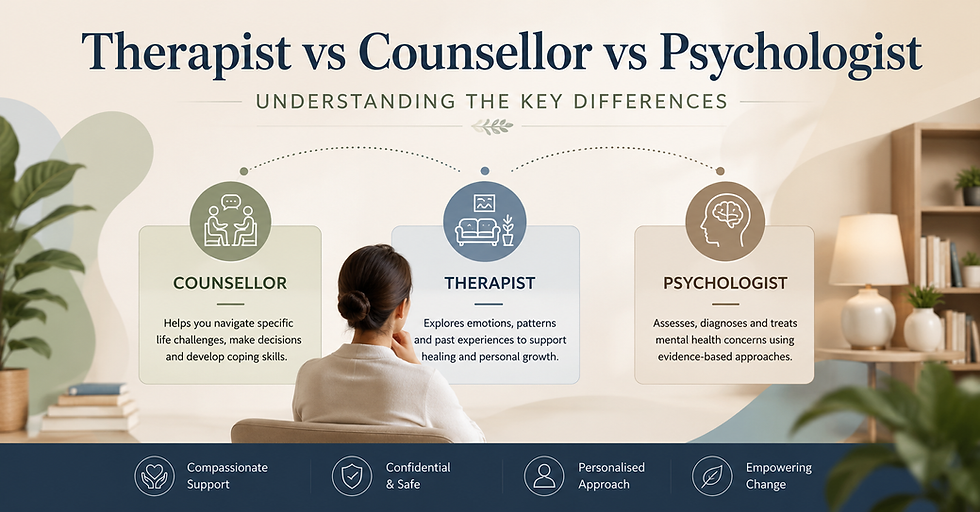
A counsellor typically helps individuals navigate specific life challenges, emotional difficulties, and transitional periods. Counselling often focuses on current concerns and practical coping strategies.
People may seek counselling for:
Relationship difficulties
Academic stress
Workplace challenges
Grief and loss
Career-related concerns
Life transitions
Family conflicts
Counselling can be short-term or longer-term depending on the individual's needs. The process often emphasizes problem-solving, emotional support, and developing practical coping skills.
When Might a Counsellor Be Helpful?
You may benefit from counselling if:
You are facing a specific challenge or life event.
You want support in making a decision.
You are experiencing stress, overwhelm, or adjustment difficulties.
You are looking for a structured space to discuss current concerns.
What Is a Therapist?
A therapist is a broad term used for professionals who provide psychotherapy or talk therapy. Depending on their training and therapeutic orientation, therapists may work with a wide range of emotional, behavioral, and relational concerns.
Many individuals seeking psychotherapy in Delhi are surprised to learn that therapists may use different approaches depending on a person's concerns, goals, and emotional experiences.
Psychodynamic therapy
Cognitive Behavioural Therapy (CBT)
Humanistic therapy
Relational therapy
Integrative therapy
Trauma-informed therapy
Rather than focusing solely on immediate problems, therapy may also explore emotional patterns, self-awareness, personal growth, and recurring relationship experiences. Different forms of psychotherapy may address both present difficulties and deeper psychological processes.
When Might a Therapist Be Helpful?
Working with an experienced psychotherapist in Delhi can provide a safe and reflective space to explore these concerns more deeply.
Understand recurring emotional patterns
Improve relationships
Explore anxiety or depression
Process past experiences
Develop greater self-awareness
Work on long-standing emotional concerns
What Is a Psychologist?
A psychologist is a mental health professional with advanced training in psychology. Depending on their qualifications and area of specialization, psychologists may provide therapy, psychological assessments, and diagnostic evaluations.
Psychologists often work with:
Anxiety disorders
Depression
Trauma-related concerns
Personality difficulties
Behavioral challenges
Emotional regulation difficulties
Some psychologists also conduct formal psychological testing and assessments that help understand cognitive, emotional, and behavioral functioning.
When Might a Psychologist Be Helpful?
A psychologist may be beneficial when:
You require psychological assessment or testing.
You are experiencing significant emotional distress.
You need support for a diagnosed mental health condition.
You want evidence-based therapeutic interventions.
Therapist vs Counsellor vs Psychologist: A Simple Comparison
Aspect | Counsellor | Therapist | Psychologist |
Primary Focus | Specific life challenges | Emotional growth and psychological change | Assessment, diagnosis, and therapy |
Approach | Often solution-focused | Varies by therapeutic model | Evidence-based psychological interventions |
Common Concerns | Stress, transitions, relationships | Emotional patterns, self-understanding, relationships | Mental health disorders, assessments, therapy |
Duration | Often short to medium term | Short or long term | Short or long term |
While these distinctions can be helpful, there is often significant overlap between the roles. Many professionals may provide similar services while using different titles.
How Do You Know Which Professional Is Right for You?
Instead of focusing solely on job titles, consider the following questions:
What Are You Hoping to Work On?
If you are dealing with a specific issue such as workplace stress, grief, or a life transition, counselling may be beneficial.
If you are interested in understanding deeper emotional patterns, recurring relationship difficulties, or personal growth, psychotherapy may be more appropriate.
If you need formal assessment, diagnosis, or specialized psychological support, a psychologist may be the right choice.
What Kind of Approach Appeals to You?
Different professionals use different therapeutic approaches.
For example:
CBT focuses on thoughts, feelings, and behaviors.
A psychodynamic therapist in Delhi may help individuals understand recurring emotional patterns, relationship difficulties, and unconscious processes that influence present-day experiences.
Humanistic therapy emphasizes self-development and personal growth.
Relational therapy focuses on interpersonal experiences and relationships.
Learning about therapeutic approaches can be just as important as understanding professional titles.
Does the Therapeutic Relationship Matter?
Research consistently suggests that one of the most important factors in successful therapy is the quality of the therapeutic relationship. Feeling understood, respected, and comfortable with your mental health professional can significantly influence the effectiveness of the process.
For this reason, finding someone whose approach aligns with your needs is often more important than choosing a specific title alone.
Frequently Asked Questions
Is a therapist the same as a counsellor?
Not always. Counselling often focuses on specific challenges and practical support, while therapy may involve deeper exploration of emotions, patterns, and personal experiences. However, there can be considerable overlap depending on the professional's training and approach.
Can a psychologist provide therapy?
Yes. Many psychologists provide psychotherapy alongside assessment and diagnostic services.
Do I need therapy even if I do not have a mental illness?
Some people also benefit from group therapy in Delhi, which offers opportunities to learn from shared experiences and interpersonal interactions in a supportive environment.
What if I am unsure whom to contact?
It is completely normal to feel uncertain. Many mental health professionals offer initial consultations that can help determine whether their approach is a good fit for your needs.
Final Thoughts
Choosing between a therapist, counsellor, and psychologist can feel confusing at first. However, understanding the differences can make the process easier and help you find the support that aligns with your goals. Rather than asking which professional is "best," it can be more useful to ask which professional is best suited to your current needs. Whether you are seeking support for a specific challenge, looking to better understand yourself, or exploring long-standing emotional patterns, in addition to individual therapy, educational resources and mental health workshops in Delhi can help individuals develop greater emotional awareness, resilience, and self-understanding.

Comments